Hetu & Luoshu
by Liu Zi Han
Mathematics PhD, I-Ching Inheritor, Weiqi 3rd Dan
Sections
-
Where do Hetu & Luoshu come from?
The origins of these two mysterious diagrams known as the Oriental Tesseract.
-
Hetu
The River Map
-
Luoshu
The book of turtle
-
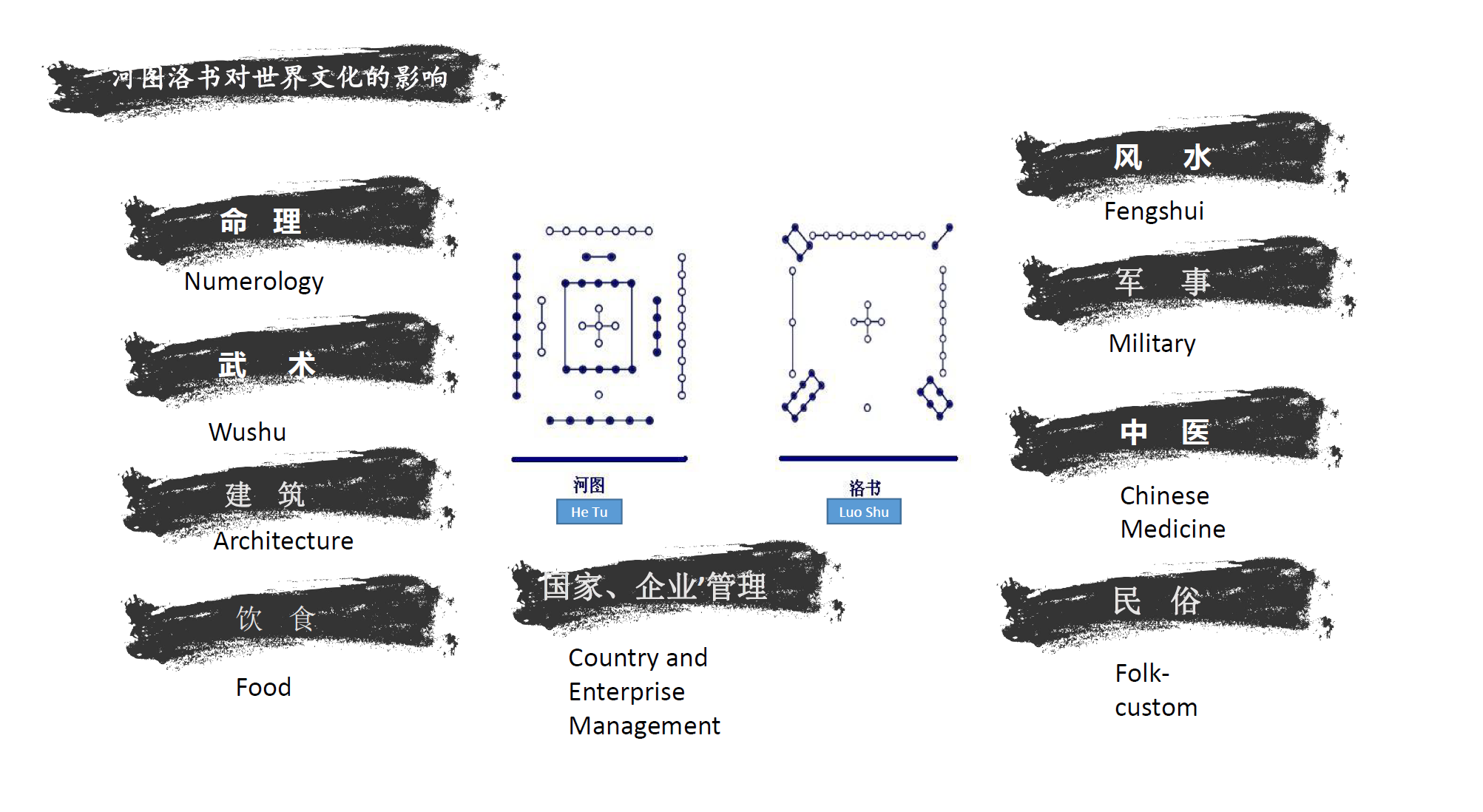
Influence on global culture
How Hetu & Luoshu influence other strands of culture
Origins
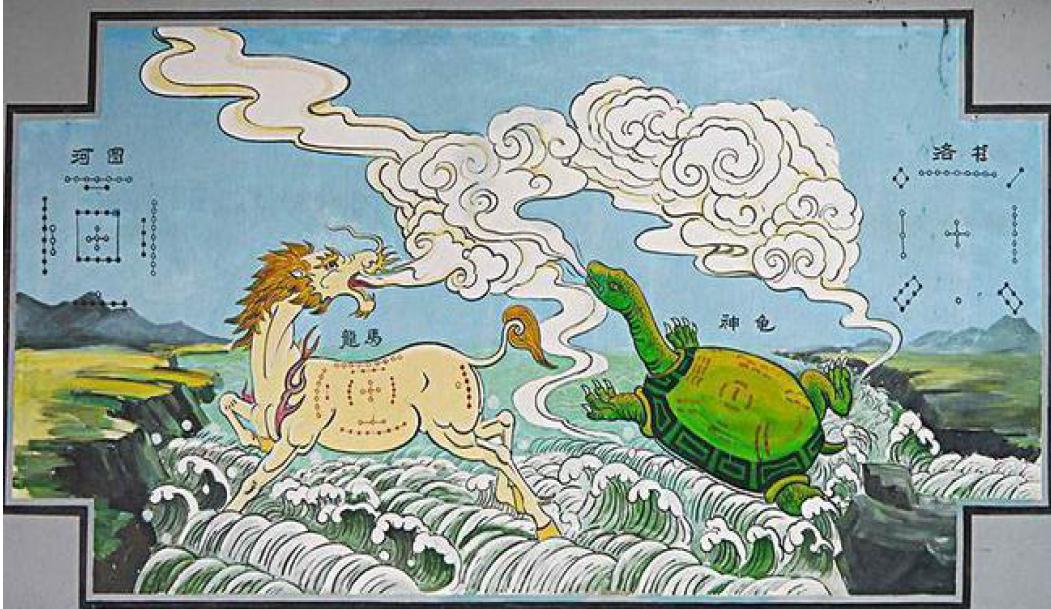
River Map (HeTu) and Luoshu are two mysterious diagrams of the origin of Chinese civilization, known as the Oriental "Tesseract". According to legend, in the ancient Fuxi period, a Dragon Horse surfaced in the Yellow River in Mengjin County, northeast of Luoyang, and a mysterious diagram on the belly of the dragon horse was the earliest source of "River map".
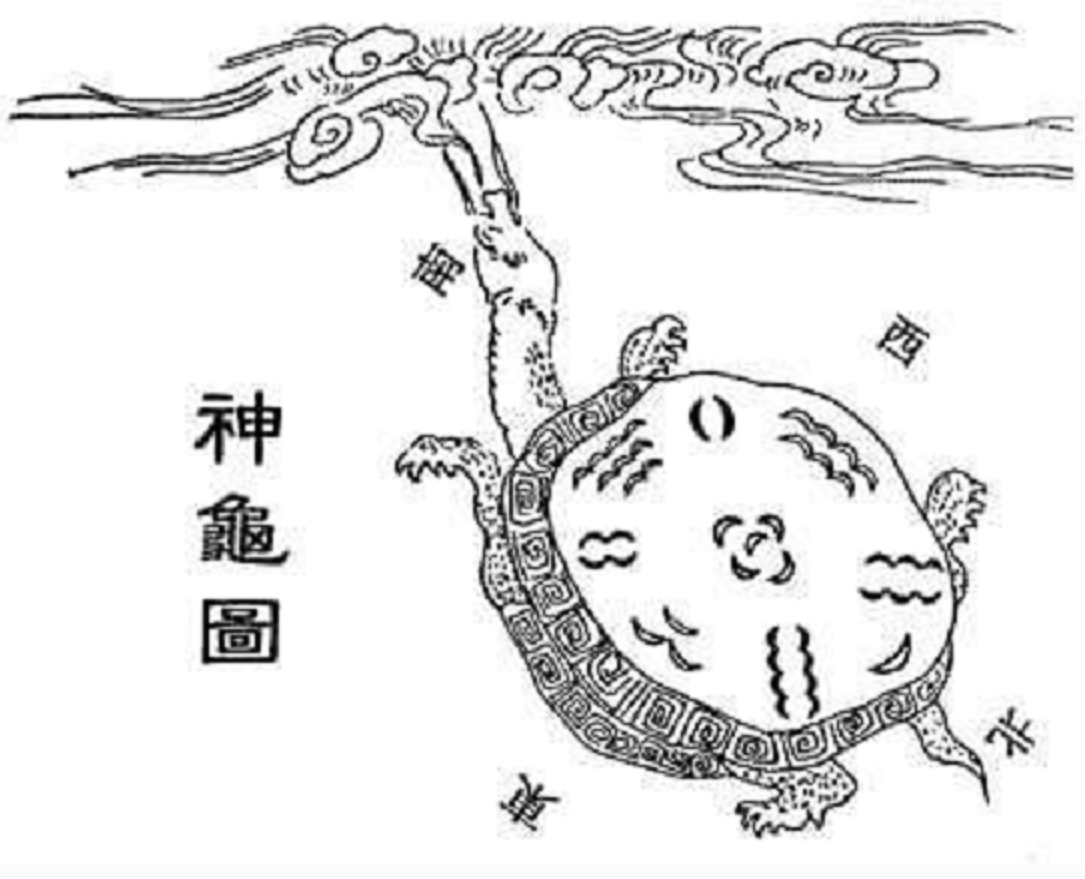
In the Period of Da Yu, a sage turtle surfaced in the Luohe River in Luoning County, west of Luoyang, with the diagram of "Luoshu" on its back. Da Yu obtained luoshu to manage the flood. After the flood control was successful, Dayu used the map to divide China into regions, forming today's Nine Areas (Jiuzhou).
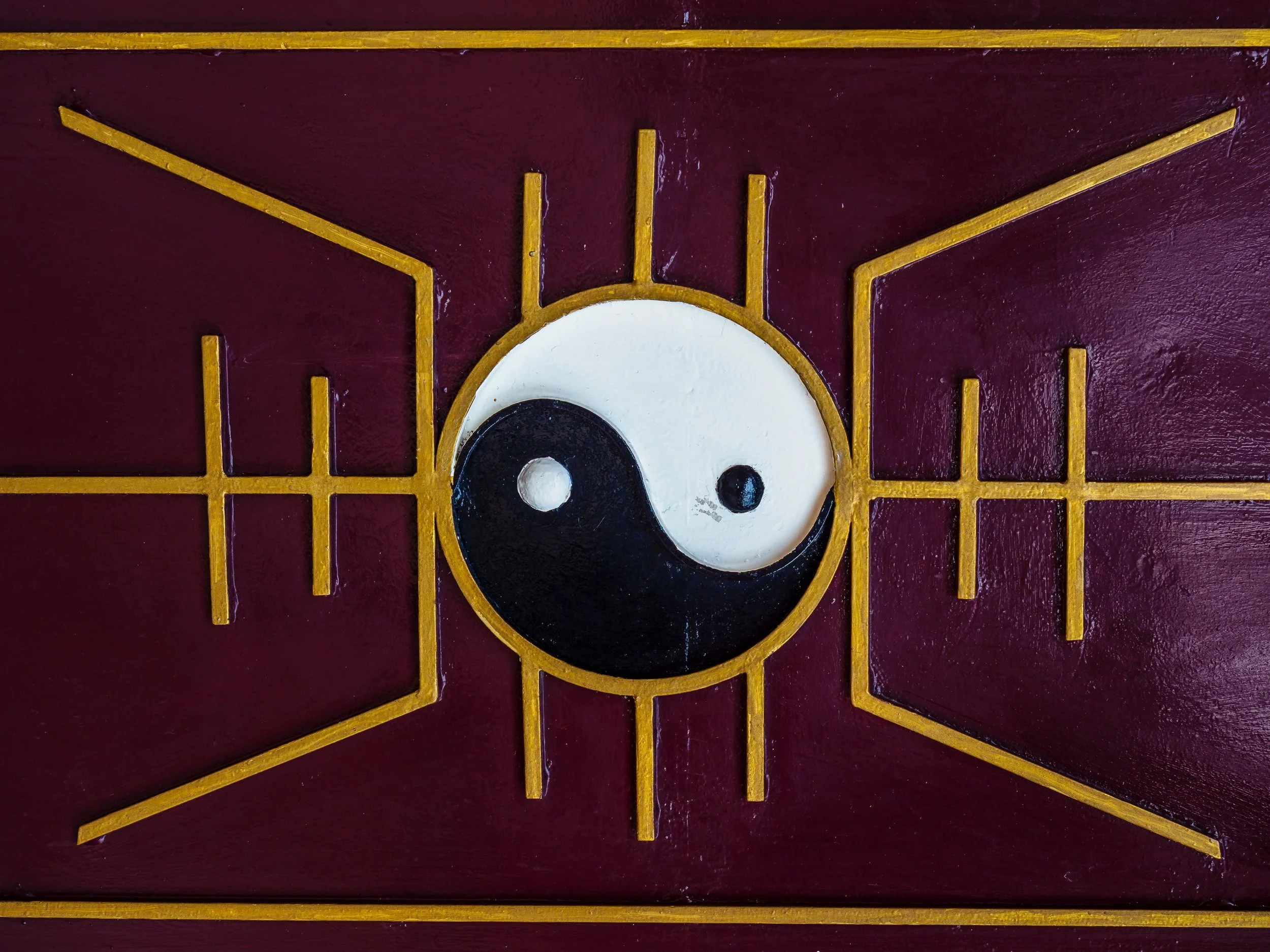
The pattern on the abdomen of the dragon horse on the left is the earliest pattern of "River Map" on the right is the earliest pattern of "Luoshu". The river Map and Luoshu are closely related to the generation of eight diagrams (Bagua), Yin Yang and five elements, Tian Gan & Di Zhi.
"Hetu Luoshu" was written 14,800 years ago. Based on this, Fuxi created the eight trigrams (Bagua), which later became the source of Zhouyi. The diagram is composed of 20 graphic symbols symbolizing Yin and Yang, with profound connotations. It is recognized as the first of many disciplines such as yi Learning, metaphysics and art in world academic circles.
Another telling resource…
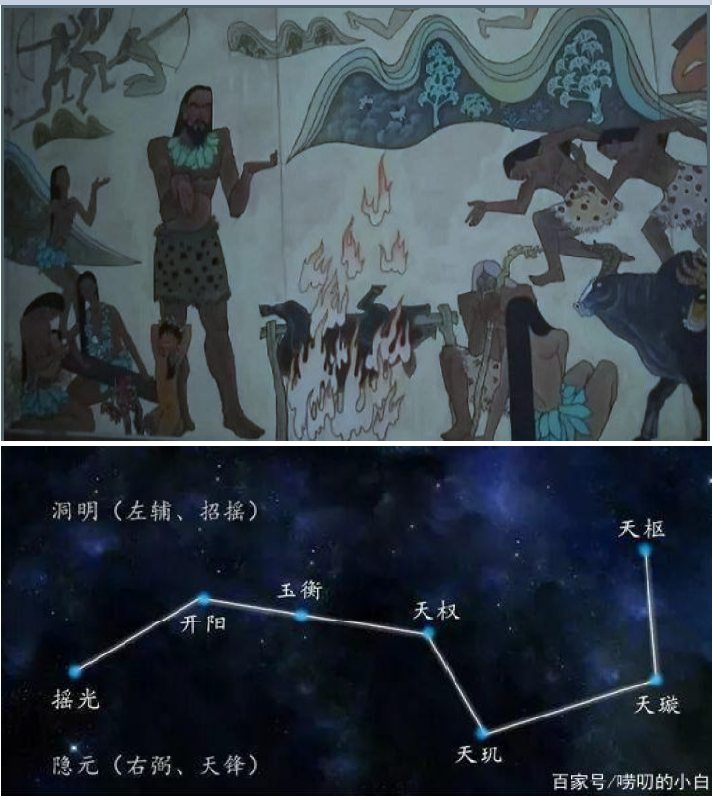
The river Map (Hetu), also known as Galaxy Cycle Picture, was created by Chieftain Koyojelao of the Green Bird Division of the Suiji Clan.
The book of Luo (Luoshu) was written by Konoyelao, chief of the Sunvbu division of the Suiji family, while observing the Nine stars of the Beidou (the Big Dipper). The big Dipper we see today is seven, First called Tianshu (S25), Second called Tianxuan (Merak), Thirs called Tianji ( Phegda), Forth called Tianquan (Megrez) , Fifth called Yuheng (Alioth), Sixth called Kaiyang (Mizar),Seventh called Yaoguang (Benetnasch), they were called the Big Dipper. In ancient times, the Big Dipper included nine stars, in addition to the above seven stars, there were also have two other stars were called Zhaoyao (star) and Tianfeng (star) in Bootes.
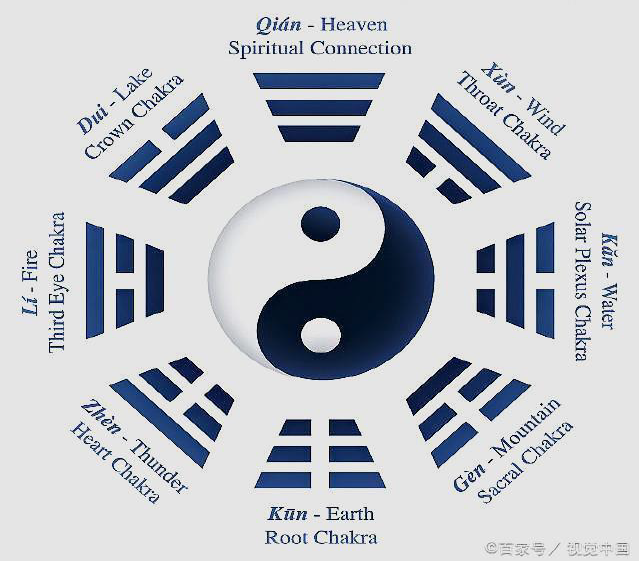
After obtaining the River Map (Hetu) and Luoshu, Fuxi studied assiduously and had deep insight. Therefore, he observed the astronomy, the starry sky and the movement of the earth, observing the changes in the activities of birds and animals, and created the "eight diagrams" (Bagua), namely Qian, Kun, Zhen, Xun, Kan, Li, Gen and Dui, as a symbol of himself and all things in nature. Fu Xi used the eight diagrams (Bagua) to communicate with the virtues of the gods and generalize the shape of everything in the world.
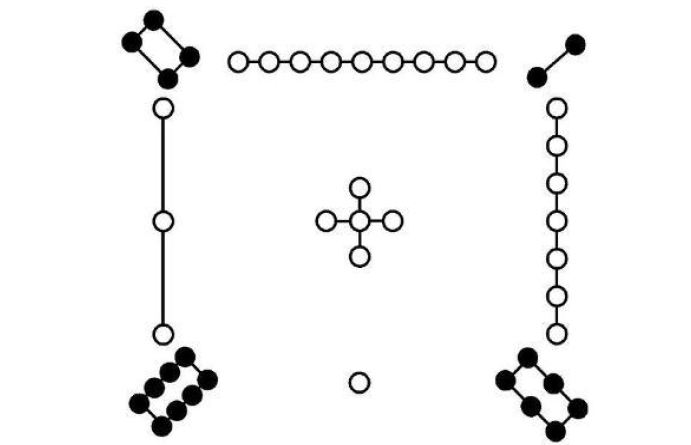
Hetu
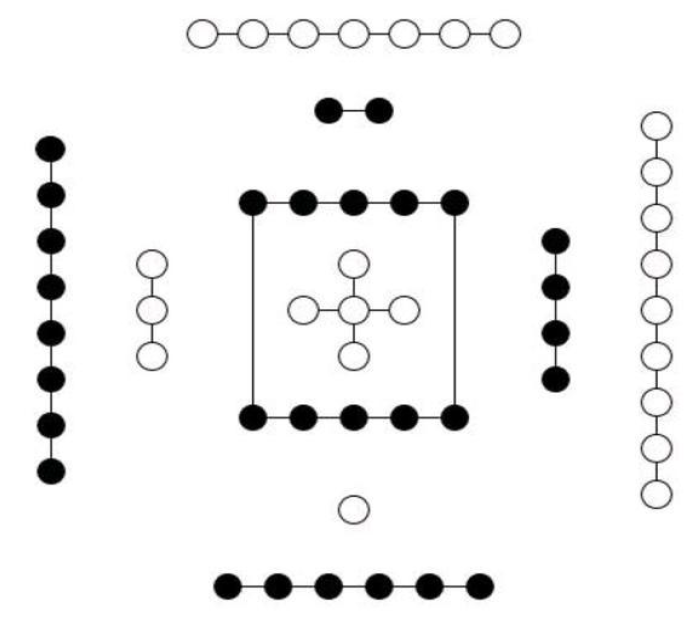
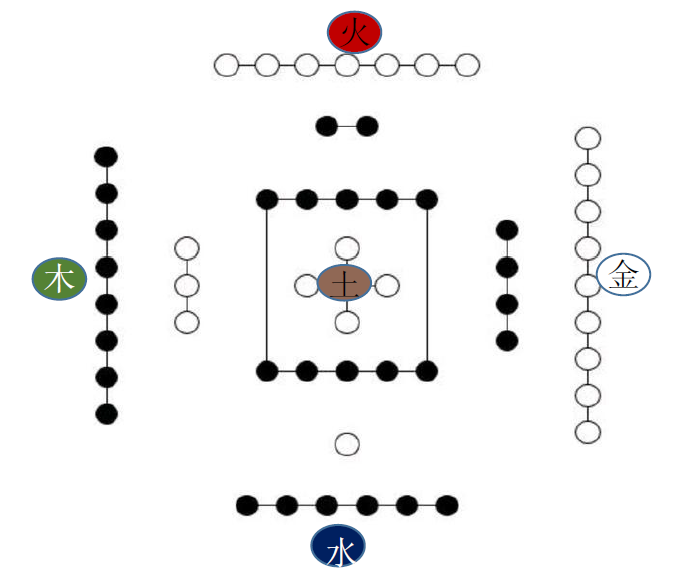
The river map (Hetu) is made up of ten black and white dots, and its diagram is square. The origin of the white indicates that Yang is odd. The black dots represent "Yin" and the even number means that everything in the world is made up of Yin and Yang, which is the Yin and Yang principle of our river map (Hetu).
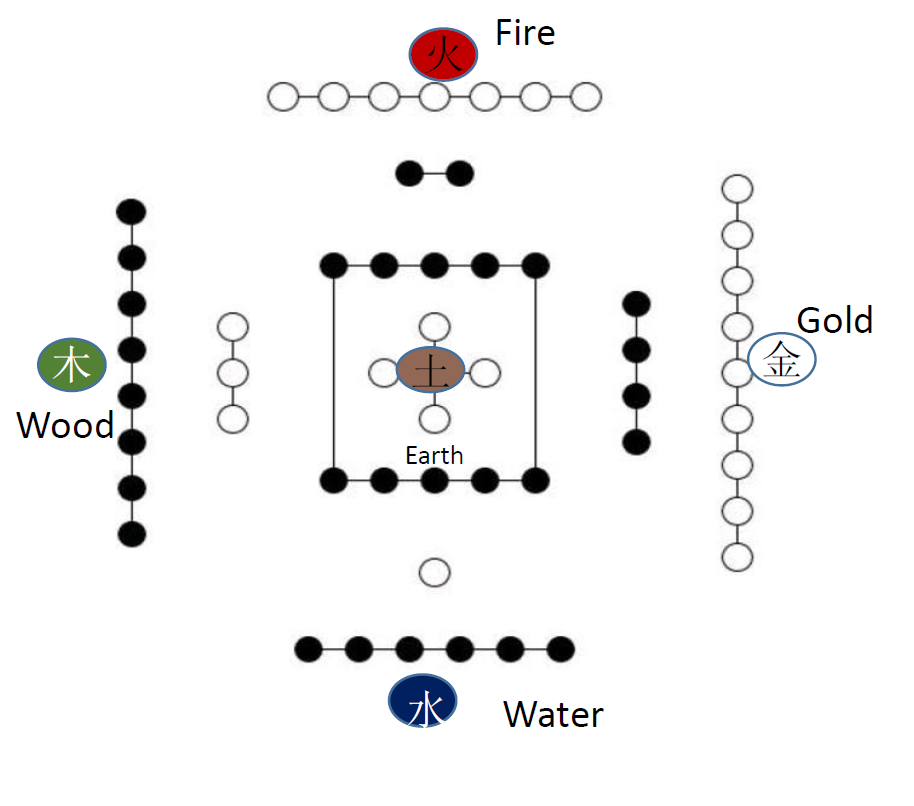
The Elements
When the Hetu rotates anticlockwise , the five elements are mutually created. Gold bears water, water bears wood, wood bears fire, fire bears earth and earth bears earth.
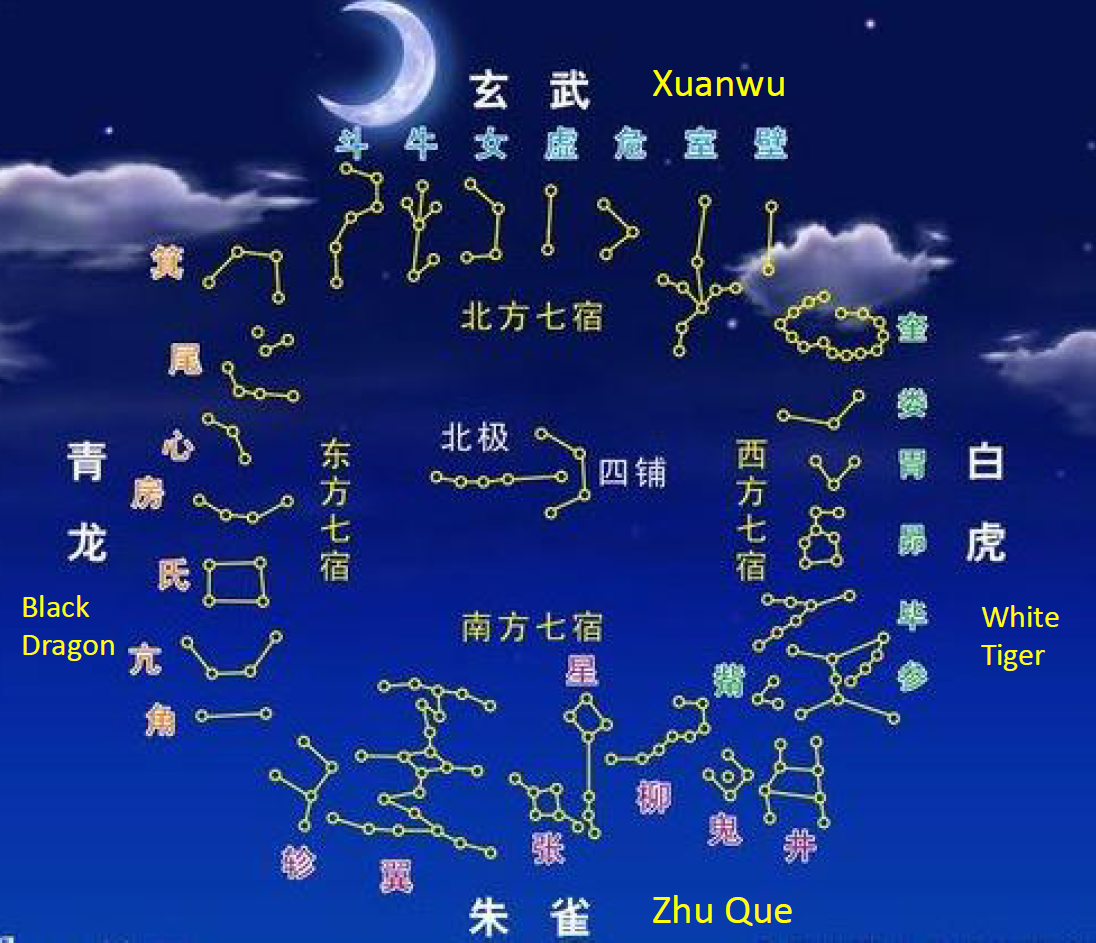
In ancient China, there were few entertainment activities in the evening, so watching the sky was the main activity. Through the night view of the sky for a long time, they through long-term observation and imagination, our sky is divided into four kinds Images. This is what we call the four Diagram (Si Xiang), and four Diagrams as corresponding to the five elements, because Hetu has the features of five elements, so the ancients combined these two types pictures, formed the North - Xuanwu, South - Zhu Que (rosefinch), Left - Black and Right - White Tiger.
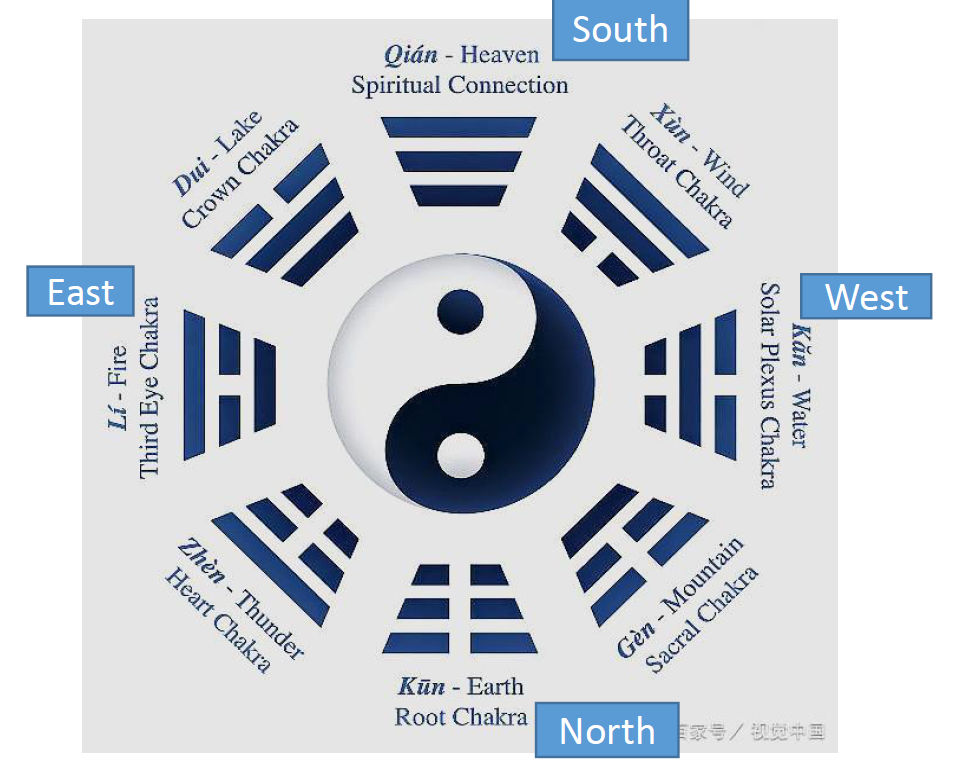
The number 1234 obtained in four directions is four images, which are generated in order: 1 for qiangua in the south, 2 for Li Gua in the east, 3 for Kan Gua in the west, and 4 for Kun Gua in the north. So Qian Kun Kan Li from the Four Diagrams (Si Xiang) in the north and south east and west are four Directions.
Luoshu
In the book of History (Shang Shu), there is a story about Hong Fan Jiuchou, Gun who destroyed the five elements and caused chaos in the world by using the method of "Blocking" to control the water. As a result, Emperor Yao was furious and Gun was killed. Later, when Dayu controlled the flood, Dayu succeeded in regulating the flood according to the rules of "Hongfan", which followed the five elements.
Luoshu was called the Book of the Turtle in antient times. It was told in the legend that there was a sage turtle surfaced on the bank of Luo Shui river, it showed the diagram on its back. Luoshu is the earliest form of the nine squares, in which white dots (1, 3, 5, 7, 9) are odd numbers and also represent Yang, and black dots (2, 4, 6, 8) are even numbers and also represent Yin.
Luo Shu: The sum of the three numbers in the vertical and diagonal is equal to 15. Such as: 2+9+4=15, 6+7+2=15 and so on.
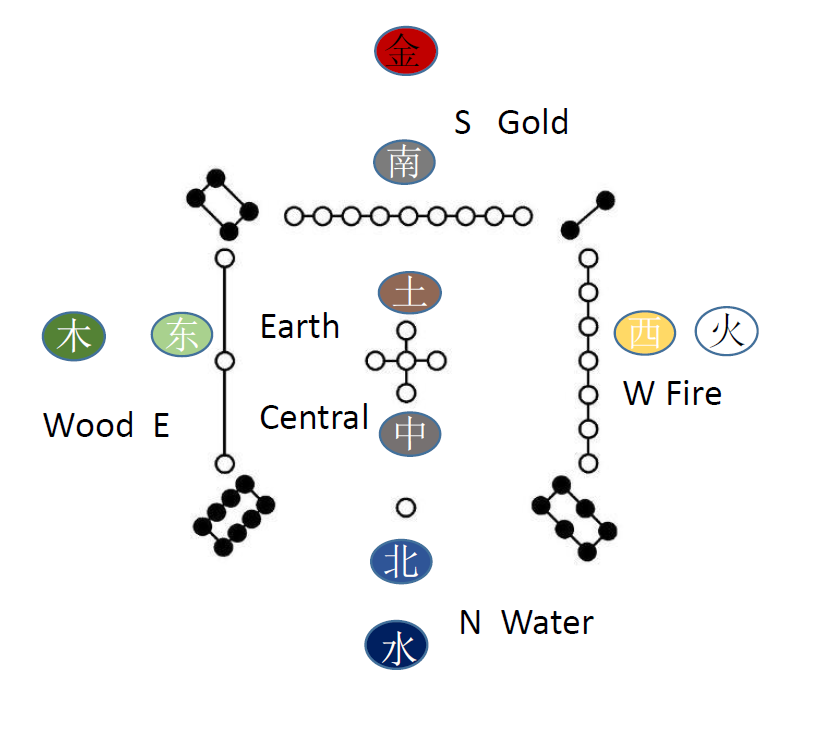
Luoshu clockwise rotation: the North -- 1, 6 -- Water restrain the West 2, 7 -- the fire; The West-- 2, 7--- the fire restrain the South -- 4, 9 --he Gold; The South -- 4, 9 -- the gold retrain the East --3, 8 --the Wood, The East -- 3, 8 -- the Wood retrain the central 5, 10 --- the Earth, central 5, 10 -- the Earth retrain the North --- 1, 6 --- the Water. The North -- 1, 6 -- the Water retrain the West --- 2, 7 --- the Fire.
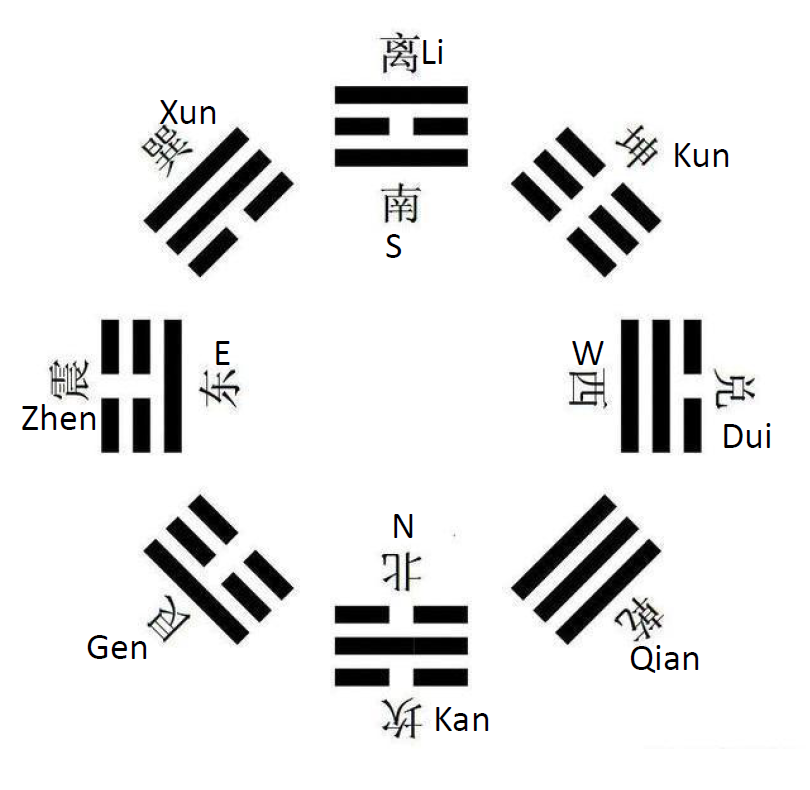
Water: to be wet, downward; Fire: to burn, upward; Wood: can be bent or straight; Gold: can change shape; Earth: crops can be planted. Later on, according to the characteristics of the five elements, the Yin-Yang philosophist assigned them direction as follows:
East: Wood (cyan)
South: Fire (red)
West: Gold (white)
North: Water (black)
Middle: Earth (yellow)
Hetu & Luoshu in culture
Ancient Greek philosopher Pythagoras and German mathematicians linked the odd and even numbers with the theory of cosmogenesis, while philosopher and binary founder Leibniz linked the odd and even numbers with god's creation of all things. According to the famous sayings of western philosophers and mathematicians, we can understand the mystery of this group of abstract symbols composed of odd and even numbers.
The Biggest mystery of Hetu & Luoshu lies in the fact that the prehistoric astronomical calendar map created by Chinese ancestors is actually a set of space-time models.
Taiji is a model of time and space: the two solstices (winter solstice and summer solstice) The space has two poles. The two solstices and the north and south poles are regarded as one entity.
Hetu Luoshu the model of time and space: Seasons in the five elements are metal, wood, water, fire and earth; Space in the five elements are East, West, North, South and Middle which are five directions; The five elements and the five directions are the corresponding relationship, is an integral relationship.
Bagua is a model of time and space: the eight terms are the Winter solstice, Summer solstice, Spring equinox, Autumn equinox, Spring Begins, Summer Begins, Autumn Begins, Winter Begins; Space are eight points, namely four directions and four corners, eight terms and eight points are the corresponding relationship, is related.